by Elsen Portugal
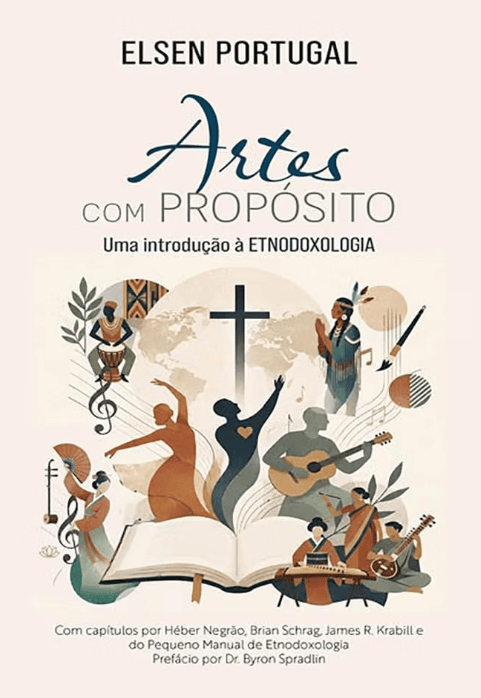
Ethnodoxology is a growing interdisciplinary field combining two major branches of the Humanities: Religious Studies (particularly in the area of Jewish and Christian practices) and Art. It inherits much content from the better-known field of Ethnomusicology, a sub-category of Fine Arts, and proposes to study the worship expressions within the context of particular cultures. The artistic focus, although not expressly stated in the term, is embedded in its presently-accepted meaning. Although the practical applications of this study are primarily related to the fields above, involving religious and artistic exercise, the field of Anthropology also plays a major part in the interaction.
The term Ethnodoxology has been growing in acceptance since the beginning of the twenty-first century, particularly through the influence of Dr. Roberta King, who defined the term in the Evangelical Dictionary of World Missions,[1] and of Dave Hall, who used it in the article called The Centrality of Worship.[2] Applications of this interaction can be seen in various parts of the world, particularly as cross-cultural workers with artistic training, or at least a keen eye for the variety of musical expressions in their particular fields, perceive the richness and potential of local music as a strategic community development tool. Some organizations already incorporate this approach into their formal strategy structure, having progressively expanded the field past the Western artistic domain category of “music” to include any and all expressive arts, comprehensively called Ethnoarts.
Artistic expression has had a complicated relationship with the various Jewish and Christian traditions throughout the millennia. The responses to the arts have been wide-ranging, varying in accordance to a particular culture’s perceptions, theological interpretations of the Scriptures, preferences, and other such concerns.This complex interface continues until the present day, although the force of restriction has diminished in comparison to earlier centuries. Accepting the following definition for Art: “the creation of aesthetic objects, environments, and experiences using skill and imagination,”[3] as the basis for any consideration, one can observe that various artistic domains are used both in the Jewish and Christian scriptures, appearing both in prophetic as in common cultural contexts. Poetry and other verbal devices, music, architecture, sculpture, dance, and drama are all positively represented in the texts. They imply not only an approval of artistic expression in the religious life of both Jewish and Christian communities, but represent the intense dependence on cultural features for the proper and clear communication of a message.
Anthropology serves as an agent of research in the field of Ethnodoxology, especially as it focuses on culture. Each society, even when sharing itsparticular aspects with others, displays unique characteristics thatdescribe or even define the life of its members. These societies or communities hold to areligious creed, or group ofcreeds, which distinguish them from others. Attached to these religious creeds, researchers find a myriad of complex rituals, creative acts, and linguistic features, which could all be classified as “art.” By means of participant observation, various interviews, and other coordinated activities, Cultural Anthropology assists and profits from a concentration on this widespread interaction between Religion and Art. An important area of research involves the multiple ways in which cultures were developed along the course of the centuries, particularly as Christianity spread to communities and continents around the world. Mostly, this interaction was characterized by an imposition of religious expression which reflected the cultural expectations of the missionaries. In some cases, on the opposite extreme, communities developed a complete syncretism of ideas and artistic symbolism. A balanced blend of content with native artistic expression seems to have been the least common result of the missionary enterprise. Without losing sight of a significant past, Ethnodoxology exists to show the relevance of this latter type of interaction today. Besides reviewing historical contacts between religious practices and the arts of local cultures, the discipline seeks to defend a communication of creeds and practices which respects the cultural identities of societies, and seeks to express them through native, local traditional forms.
This approach, as suggested above from a historical perspective, does bring challenges for church leaders and members of both Jewish and Christian communities even in the present day. The variety of worship expressions throughout the world often comes as a shockeven to well-informed religious leaders. The common global context today regularly ignores minorities, both as people and as representatives of significant cultures. This study represents a relevant aspect of academic survey, affecting and broadening the understanding of religious communities as to their significance, and providing balanced methods for cross-cultural workers in their collaboration with minority societies.
The artistic field has broadened overthe course of time, as the academic world has becomebetter acquainted with ethnological phenomena around the world. What was once understood as standard, or even normative, in Western society, has become a still very significant part of an enormously complex plethora of artistic expression worldwide. Anthropologists have advanced in knowledge exponentially in this area during the twentieth century, aided also by specialists in the field of Ethnomusicology. A more particular look at the interaction between art and religious expression in non-Western contexts promises to expand this understanding yet further, providing the academic community with yet a clearer view of the cultural reality around the world.
Elsen Portugal
Hot Springs, AR
This article was submitted for review at B. H. Carroll Theological Institute, Irving, TX on August 18, 2016 as part of PhD track Seminar.
Bibliography
Boundless. Art History, Volume I: Prehistoric-1400. Boundless, 2013. Kindle Edition.
Hall, Dave. “The Centrality of Worship,” Mission Frontiers, June 2001.
Shubin, Russell G. “Worship That Moves the Soul, A Conversation with Roberta King,” Mission Frontiers, June 2001.
[1] “Ethnomusicology,” R. King in the Evangelical Dictionary of World Missions, Scott Moreau, Ed., Grand Rapids: Baker Books, 2000, 327.
[2] Dave Hall, “The Centrality of Worship,” Mission Frontiers (June 2001), http://www.missionfrontiers.org/issue/article/the-centrality-of-worship (accessed August 11, 2016).
[3] Boundless, Art History, Volume I: Prehistoric-1400 (Boundless, 2013), 35. Kindle Edition.



Leave a comment